


Your house may have worked perfectly when you bought it. Now the spare bedroom doubles as an office, the kitchen feels crowded, and you're wondering whether the backyard has enough room for an addition.
If you like your Raleigh neighborhood, renovating has obvious appeal. You could keep the location you know, avoid moving, and potentially retain your existing mortgage. But adding space may involve more than hiring a contractor and choosing finishes.
Another existing home might already have the layout you need. A newly built home in Raleigh, Cary, or elsewhere in the Triangle could offer a different combination of bedrooms, storage, and workspace. Or perhaps you've considered building a custom home designed around your needs.
Each path solves a housing problem differently. Renovating means changing a property you already own. Buying another existing home means evaluating what someone else has built and maintained. Purchasing from a production builder is different from commissioning a custom home, and tearing down an existing house to rebuild introduces another set of decisions.
The better choice isn't necessarily the one with the lowest advertised price. It's the one that meets your needs in a location you want, with costs, financing, and timing you can manage.
Here's how to compare those choices before committing.
First, Decide Whether the Problem Is Your House or Its Location
Before meeting with contractors or touring homes, identify what isn't working.
If you need a dedicated office or more kitchen storage, changing how you use your existing space might solve the problem. A kitchen remodel, better storage, or converting an underused room could make staying attractive.
But what if you need two additional bedrooms, a different bedroom arrangement, and more space for everyday activities? Those changes may require an addition or major interior reconstruction.
There's also a difference between wanting more square footage and needing a better floor plan.
A larger house with awkwardly arranged rooms may not function as well as a smaller one with a layout that suits your needs. Consider how the rooms connect, whether existing space goes unused, and what would have to change to make the house work better. Our guide to home square footage explains why reported living area is only part of that comparison.
Location is the other major question.
Suppose your current Raleigh home is convenient for work, appointments, and the places you visit regularly. Moving to another part of Raleigh, Cary, or Durham could provide the space you need while changing those trips.
On the other hand, if your current location no longer suits your routine, an expensive renovation won't fix that.
Compare the actual routes from properties you're considering to the destinations that matter to you. Your starting address, departure time, and travel frequency can matter more than a general estimate for a city.
It also helps to establish your financial and timing limits early. A project that requires more cash than you can comfortably commit, or leaves you without usable living space when you need it, may not be practical even if the finished house would be appealing.
Once you know which problems can be solved within your existing home and which require a different property, the comparison becomes more manageable.
Renovating: Keep the Location, Change the House
Renovating starts with an advantage: you already know the property.
You've experienced its layout, surroundings, and maintenance needs. If you're satisfied with the location and have a mortgage with terms you'd prefer to keep, improving the house may be worth exploring before moving.
The scope of the project makes an enormous difference, though.
Updating a kitchen is different from removing a structural wall. Converting unfinished space into a bedroom raises questions that changing the flooring doesn't. Adding a second story can require structural engineering, while extending the house into the backyard introduces additional site considerations.
Before comparing prices, determine what kind of work your home actually needs.
A large backyard doesn't automatically mean room for an addition
Imagine a homeowner in Raleigh who wants to extend the house into the backyard. There's plenty of grass, and an addition appears to fit comfortably.
That doesn't establish that the project can be approved.
Raleigh's residential addition requirements cover projects such as garage enclosures, sunrooms, second-floor additions, and converting unheated areas into heated living space.
Depending on the proposed work, the city may require site plans, construction drawings, structural information, and other approvals.
The property itself matters just as much as the proposed design.
For example, Raleigh regulates impervious surfaces—areas such as roofs and paved driveways that limit how much rainwater can soak into the ground.
Under the city's residential stormwater guidance, some lots have individually assigned impervious-surface limits, others are governed by applicable zoning limits, and some have no maximum limit.
An addition or expanded driveway could require additional analysis, changes to the proposal, or stormwater measures. A large yard doesn't necessarily provide unrestricted building space.
Setbacks, easements, existing drainage, and other property conditions can create additional constraints. Setbacks can require buildings to remain a certain distance from property lines or street rights-of-way, depending on the applicable rule. Drainage easements reserve space for water flow or drainage infrastructure and can restrict where structural walls are placed, even when that part of the yard looks open.
That's why it's worth checking what the property can accommodate before investing heavily in a design that depends on expanding the building footprint.
Septic systems, historic designations, and HOA rules can affect the plan
The questions change with the property and jurisdiction.
For a septic-served home in Wake County, adding another bedroom can involve more than making room inside the house.
Wake County's home alteration guidance explains that an increase in bedroom count requires review of the septic system's size and function. An addition also must account for existing wastewater components, wells, required setbacks, and the area reserved for possible future septic repairs.
You might have enough room to build an addition but not enough suitable area to accommodate the wastewater requirements without further work.
Our guide to buying a Wake County home with a septic system explains why system records and the available land deserve attention.
Historic properties can bring another kind of restriction.
Covered exterior changes to a home in a locally designated Raleigh historic district, or to a Raleigh Historic Landmark, may require a Certificate of Appropriateness—a separate local historic-preservation approval—in addition to ordinary permits. Being old or listed on the National Register of Historic Places doesn't automatically create the same local requirements. Our older and historic Raleigh home guide explains those distinctions.
Cary has its own residential alteration and addition process. The town notes that lot-specific setbacks and development constraints can depend on factors such as property shape, natural buffers, easements, and zoning.
If your property is part of a homeowners association, review its architectural requirements as well. Association approval and government permits are separate matters. Our Raleigh-area HOA guide explains what to examine in the governing documents.
The important distinction is that Raleigh's permitting rules don't automatically apply to every Triangle municipality. Wake County building-permit authority also differs by location, while county wastewater review can remain relevant to certain municipal projects.
Verify the requirements for your actual address and proposed work, rather than relying on a mailing city or what another homeowner was allowed to build.
Compare what contractors are actually proposing
Once the project appears feasible, obtain detailed estimates from qualified contractors.
The North Carolina Licensing Board for General Contractors states that a general contractor must be licensed for a project valued at $40,000 or more. You can check an individual's or company's license using the state's contractor search.
That licensing threshold is not permission to complete lower-cost work without necessary permits or trade licenses. Owner-builder exceptions also have conditions and shouldn't be assumed to apply.
Compare proposals based on what they include, not simply the total at the bottom.
One contractor might include demolition, engineering, electrical work, flooring, and cleanup. Another could leave some of those items out or use different allowances for finishes—the amounts budgeted for materials such as tile or fixtures. Compare the specified materials, quantities, quality, and prices, not just the total cost of each proposal.
Ask about the construction scope, excluded work, materials, permits, start and completion provisions, payment schedule, insurance, and how changes will be approved and priced.
The Licensing Board's remodeling-contract guidance recommends written agreements, payments tied to completed work, written change orders, insurance verification, and clear warranty terms. It also advises obtaining appropriate lien releases before final payment and retaining project documentation.
For substantial work, ask a North Carolina attorney about payment documentation and applicable lien protections. A construction lien can secure a qualifying unpaid construction debt through a claim against the property, which is why payment records and appropriate lien releases matter. The state's lien-agent rules include project-specific exceptions; those exceptions shouldn't be mistaken for a guarantee that unpaid-contractor lien problems cannot arise.
And leave room for uncertainty. Opening walls may reveal damage or outdated systems that weren't evident when the estimate was prepared.
You should also determine whether you can live in the house during construction. Losing access to a kitchen or bathroom can create temporary housing and storage expenses.
Renovating may spare you a permanent move, but it doesn't necessarily spare you from disruption.
Buying Another Existing Home: Get the Layout Without Building It Yourself
Suppose your current house would need a major addition to provide another bedroom, a dedicated office, and a larger living area.
Instead of constructing those rooms, you could look for an existing home that already has them.
That's the primary appeal of buying another house: you can evaluate the actual layout before committing to it.
You can walk through the bedrooms, see how the kitchen connects to the living areas, inspect the yard, and determine whether the property suits your daily routine.
You may also find that a different existing floor plan provides what you need without increasing your total square footage as much as you originally imagined.
But buying an existing home doesn't eliminate property-condition concerns.
A house with the ideal layout might need roof work, mechanical repairs, or other improvements. A finished addition may warrant investigation into permits, construction quality, and how the space is reported.
Include the cost of selling and moving
If you already own a home, the purchase price of the next property is only part of the financial comparison.
Start by estimating the proceeds from selling your current home after the existing mortgage is paid off and actual selling expenses are deducted.
That net amount—not the home's full market value—is what may be available to help finance the next purchase.
The new home can bring a down payment, closing costs, insurance, taxes, moving expenses, and possible repairs. Association dues may also differ.
Our Raleigh-area closing-cost guide explains the expenses beyond the down payment.
Then consider the timing.
If you sell your current home before buying the next one, you may need temporary housing or another arrangement between closings.
If you buy first, you could carry two housing obligations for a period and may not have the proceeds from your sale available when the next purchase requires them.
Neither sequence is automatically better. The practical choice depends on financing, available funds, contract dates, and the properties involved.
Our preparing-to-sell guide can help you evaluate which improvements and preparations are worth considering before putting your current home on the market.
An existing home still needs a thorough investigation
North Carolina's commonly used resale Offer to Purchase and Contract, Form 2-T, provides for a negotiated due-diligence period.
As the North Carolina Real Estate Commission explains, that period can be used for inspections, surveys, appraisal, title review, financing, and repair negotiations.
A seller isn't automatically required to agree to repairs, and a buyer shouldn't assume that money already paid will be refunded if the transaction doesn't proceed. The signed contract controls, including its deadlines and applicable exceptions.
If an inspection identifies a concern, determine whether a specialist should evaluate it and how the findings affect your decision. Our North Carolina inspection-repair negotiation guide explains that process.
Buying another existing home may be especially attractive when it solves several layout or location problems at once, without requiring you to manage a substantial renovation.
The key is comparing the complete purchase and moving costs against what changing your current property would require.
Buying New Construction: Understand What the Builder Is Offering
New construction is another option, but buying from a production builder isn't the same as commissioning a custom house.
Production builders typically offer established floor plans, exterior styles known as elevations, and choices of finishes within a particular development. Buyers choose among the available homes, individual building lots called homesites, and options.
The stage of construction can change the experience.
A completed inventory home—a house the builder has already built for sale—lets you evaluate more of the finished product. A home already under construction may have limited remaining choices. Selecting a plan before construction begins may offer more personalization, but only within the builder's available options and contract.
Those distinctions affect your ability to customize the home, what you can inspect before purchasing, and when possession may occur.
Look beyond the starting price
Consider Pulte's Murray floor plan at Exchange at 401 in Raleigh.
The builder presents floor-plan selections, interior and exterior options, and information about quick-move-in choices. Its disclosures explain that prices, incentives, features, and plans can change, and that the actual position of a house depends on the site and plot plans.
This illustrates an important distinction: the advertised starting price or model home isn't necessarily the price or configuration of the property you'll purchase.
Before building your budget around a plan, obtain the actual price for the proposed home, homesite, and selected options.
Ask which structural features, finishes, appliances, and exterior improvements are included. Determine whether a homesite premium, design selections, or other charges affect the final amount.
Also review community restrictions, association dues, and any future obligations identified in the documents.
A floor plan that looks ideal may not be offered on every homesite. And a currently advertised plan doesn't prove that a particular lot or completed home is available.
Builder contracts and incentives require their own review
A builder's contract may differ substantially from the forms commonly used for existing-home resales.
Before signing, understand the treatment of deposits, cancellation provisions, selection deadlines, changes, inspections, construction delays, completion obligations, and warranties.
Don't assume that a builder contract provides the same investigation period or termination rights as a standard resale agreement.
Builder financing offers also deserve attention.
If a builder offers a credit toward closing expenses or an interest-rate incentive, request the written conditions. Some offers may depend on a designated lender or other transaction requirements.
Compare the full financing terms against other offers rather than assuming the largest advertised credit is the least expensive choice.
The Consumer Financial Protection Bureau's Loan Estimate guidance can help you evaluate rates, lender credits, points, cash to close, and ongoing payments.
Don't skip inspections because the home is new
Official building-code inspections and a buyer's independent home inspection serve different purposes.
The North Carolina Real Estate Commission recommends independent inspections even for newly constructed homes.
A general home inspection is visual rather than exhaustive, and it doesn't guarantee that future defects won't appear.
Clarify inspection access and timing in the builder's contract. Review the written warranty to understand what it covers, how long coverage lasts, and who is responsible for addressing issues.
New construction can make sense when the builder's actual offerings provide the layout and location you want without extensive work after purchase.
But a new house isn't automatically the better choice simply because it's new.
Building a Custom Home: More Control Over the Design, More Decisions Along the Way
Production new construction may not offer the layout or design you're looking for.
If you have specific requirements that existing homes and builder plans don't meet, a custom home may deserve consideration.
You generally have more influence over the design, but you also take on decisions about land, architectural plans, construction, financing, and the finished property's specifications.
And the first major question may not involve the house at all.
Is the land suitable for what you want to build?
A vacant lot isn't automatically a buildable lot for your proposed home.
Depending on the property, setbacks, easements, drainage, grading, utility service, well or septic requirements, and other conditions may affect the design and budget.
Even when a lot is generally buildable, its usable building area may be smaller than its total acreage suggests.
For example, a site that appears large enough for a house and detached garage may have restrictions affecting where those structures can be placed.
Before buying land based on a specific design, investigate its suitability with the appropriate planning and permitting offices and qualified professionals.
Raleigh has a separate permitting process for new single-family dwellings, including applicable site and construction documentation.
Other Triangle jurisdictions use their own review processes. A builder's experience on one property doesn't establish approval for another.
Custom construction budgets also need to account for the actual site.
Depending on the circumstances, engineering, grading, drainage improvements, utility connections, driveway construction, and other preparation work may be necessary.
Those expenses shouldn't be assumed to be included in a quoted house-construction price.
Financing custom construction is different from buying a completed home
Someone purchasing a finished builder-owned home may be able to use ordinary purchase-mortgage financing, subject to lender and program requirements.
Commissioning a custom house on land you own or are acquiring may involve a construction loan instead.
The CFPB explains that construction loans generally provide short-term financing, with money commonly advanced as work progresses.
Construction financing often has higher rates than longer-term mortgage financing. Depending on the arrangement, the balance may be paid off or converted into a permanent mortgage. Some loans require a new application rather than an automatic conversion.
Ask prospective lenders how the draw process works, when payments begin, what cash you'll need, and what happens if construction takes longer or the financing must be replaced.
If you still own your current home, the timing and amount of those obligations become especially important.
A custom home can provide flexibility that other choices don't. But design control doesn't eliminate construction, site, financing, or completion risks.
Tearing down and rebuilding is a separate decision
What if you love your current location but the house itself would require extensive reconstruction?
Replacing the building may be an option worth investigating.
Still, tearing down a house isn't simply another form of remodeling.
Raleigh has a separate residential demolition process, and constructing the replacement involves its own permitting requirements.
The fact that a house already occupies the lot doesn't establish that a different structure—with a larger footprint, different height, or altered placement—will be permitted.
Stormwater requirements, setbacks, historic designations, utilities, demolition conditions, and financing can all affect feasibility.
Demolition also requires checking applicable utility-disconnection and hazardous-material obligations. An exemption under one specific rule should not be interpreted as permission to ignore all such requirements.
If the property has an existing mortgage, discuss the proposed demolition and replacement with the lender before proceeding.
The same care applies when considering a property for purchase primarily because you want to remove the existing house.
A teardown may allow you to keep or acquire a location you value. It doesn't guarantee that the replacement design will be permitted or that rebuilding will cost less than buying another suitable home.
Compare the Full Financial Commitment, Not Just the Headline Prices
The financial comparison is easy to distort because the numbers represent different things.
A renovation estimate describes proposed construction work. A resale purchase price is the price of an existing property. A production builder's base price may omit options you want, while a custom construction quote may leave out land and site preparation.
These figures aren't directly interchangeable.
To compare them, examine how much cash each option requires, what you'll owe each month, and what financial exposure remains if circumstances change.
How much cash will you need, and when?
For renovation, consider design, engineering, permits, construction, possible temporary housing, financing costs, and money reserved for unexpected work.
For another home purchase, consider the down payment, closing expenses, moving costs, and necessary improvements. If you're selling your current home, account for the timing of its net proceeds.
For production or custom construction, examine deposits, options, land acquisition where applicable, site preparation, financing expenses, and costs excluded from the building contract.
These aren't identical kinds of expenses.
A down payment contributes toward ownership equity. Loan fees, moving charges, and contractor payments serve different purposes. But each can affect how much cash you need available at a particular time.
Don't evaluate affordability solely by asking whether you can make the first payment.
Consider how much reserve will remain after the work or purchase, especially if costs change or your household experiences an unexpected expense.
Will you keep your current mortgage or replace it?
For homeowners considering renovation, the existing mortgage deserves particular attention.
A home-equity loan or home-equity line of credit may allow you to borrow against your property's equity while retaining the first mortgage, subject to lender terms.
But that introduces an additional debt obligation.
The CFPB explains that a HELOC allows borrowing against available equity, generally with a variable interest rate. Payments can change, including potentially significant increases during repayment. Lenders may restrict additional borrowing under specified circumstances.
Because the home secures the debt, failure to repay can put the property at risk.
A cash-out refinance works differently. It replaces your existing first mortgage, potentially changing the terms on the full refinanced balance.
That difference matters if your current mortgage terms are favorable.
There are also specialized renovation loan programs.
HUD's FHA 203(k) program, for example, can combine eligible purchase or refinance financing with rehabilitation of a home that's at least one year old. Rehabilitation proceeds are held and released under program procedures.
Eligibility, property requirements, project scope, lender participation, and underwriting all matter. It's a financing option to investigate, not a guaranteed benefit or grant.
Custom construction financing, meanwhile, may involve a separate borrowing and payment structure.
The right comparison depends on actual written lender terms, not assumptions about which type of borrowing will be least expensive.
What will the ongoing ownership cost be?
When comparing homes, examine more than principal and interest.
Property taxes, homeowners insurance, mortgage insurance when required, association dues, and possible assessments can change the monthly picture.
Some expenses may already be included in the lender's payment estimate through escrow. Others may be paid separately. Don't accidentally count escrowed taxes or insurance twice.
Ask lenders to provide comparable Loan Estimates using the same loan type, term, and rate-lock assumptions where possible.
Review the interest rate, points, lender credits, estimated closing costs, cash to close, and projected payments.
Also consider any period when you may carry the mortgage on your current property alongside obligations for another purchase or construction project.
A choice that appears affordable once everything is finished may require significantly more cash during the transition.
Leave room for what you can't know yet
Every path carries uncertainty, although it takes different forms.
Renovation may uncover structural or system problems. An existing-home inspection may identify expenses you hadn't anticipated. Production construction can involve changes or delays governed by the contract. Custom building adds site conditions, design decisions, and construction-financing exposure.
No universal Triangle renovation price, construction cost per square foot, or predicted resale return can settle those differences for every property.
Nor is there a sound basis for assuming that every dollar spent renovating will be recovered when you sell.
Compare documented costs for realistic alternatives, then ask what happens if the project becomes more expensive or takes longer than planned.
That's a more useful financial test than declaring one approach universally cheaper.
How Long Can You Wait for the Space You Need?
Cost isn't the only constraint. Timing can change which option is practical.
If you need another bedroom immediately, a major renovation may be difficult to accommodate, particularly if significant areas of the house become unusable.
Buying an existing home avoids waiting for that house to be constructed, but inspections, financing, closing dates, your current sale, and moving arrangements still require coordination.
Production new construction can involve purchasing a completed house or waiting for one that's still being built.
Custom building introduces design, site preparation, permitting, financing, and construction stages. A teardown adds demolition before replacement construction can proceed.
Published permit-review estimates shouldn't be mistaken for total construction schedules.
And a builder's projected completion date isn't necessarily the date you can legally occupy the property or take possession under the contract.
For example, Raleigh's Certificate of Occupancy guidance explains that a new building cannot legally be occupied until the applicable inspections are complete and a Certificate of Occupancy has been issued.
That official approval serves a different purpose from a buyer's independent inspection.
Before committing to any option involving construction, establish who is responsible for each stage, what must occur before occupancy, and how the agreement addresses delays.
If you're coordinating a sale with a renovation or new build, investigate the financial and housing arrangements you'll need if the dates don't align.
A plan that depends on everything happening exactly on schedule may leave you with very little room to adjust.
Which Option Is the Better Fit?
Consider how different circumstances could change the answer.
A Raleigh homeowner who needs a more functional kitchen and a dedicated office might find that a targeted renovation solves both problems while preserving a location and mortgage they value.
For that person, obtaining renovation estimates before beginning a home search could be worthwhile.
Another homeowner needs more bedrooms and an entirely different layout. Their proposed addition involves significant structural work, while their property has setbacks or wastewater-system limitations that require further investigation.
Comparing existing homes could provide an appealing alternative, especially if another property offers the space they need without a major construction project.
A third homeowner wants a particular design that existing homes and production-builder plans don't offer. They have more flexibility in timing and the resources to investigate land, construction, and financing.
Custom building might be worth the additional work—if the site and project prove feasible.
These are hypothetical situations, not predictions about what any particular household should choose.
The useful question is what evidence would change your decision.
Compare actual alternatives before committing
If renovation appears attractive, start with a feasibility discussion and sufficiently detailed contractor proposals. Find out which changes are practical and what the work would involve.
If moving seems more reasonable, compare existing homes that genuinely meet your space and location requirements. Account for property condition, purchase expenses, selling costs, and the sequence of transactions.
If production new construction is appealing, obtain specifications and pricing for the actual home or homesite and review the builder's contract before relying on an advertised plan.
For custom construction or a teardown, establish basic site feasibility, preliminary professional estimates, and financing requirements before making substantial commitments.
You can explore homes across Raleigh and other Triangle communities to see how available layouts and locations compare with your current property. Our home-buying process guide explains the steps involved when purchasing another home.
Then bring the financial picture together.
How much cash would each option require before completion? What would your monthly obligations look like afterward? Would you need temporary housing, carry two mortgages, or leave room for construction changes?
Most importantly, would the finished result solve the problem that started your search?
An addition that doesn't fix an awkward layout may not be money well spent. A larger home in an inconvenient location might trade one frustration for another. And a custom house isn't necessarily worthwhile if a suitable existing home meets your needs with less complexity.
The Right Answer May Be to Stay—or to Start Somewhere New
Renovating, buying another existing home, and building new can all improve your living situation. Each asks you to accept different tradeoffs.
Renovating can preserve the location and mortgage you value, but the house and lot may limit what's possible.
Another existing home may offer the layout you need without a major construction project, although buying, selling, and property-condition costs still matter.
Production new construction provides established plans and varying levels of personalization. Custom building offers greater design flexibility while requiring more decisions about land, construction, financing, and timing.
A teardown may preserve a desirable lot, but it doesn't remove the need to establish what can legally and practically replace the existing house.
The decision becomes clearer when you stop comparing the appeal of each idea and start comparing what it would actually take to carry it out.
If you're deciding whether to renovate or move elsewhere in Raleigh or the Triangle, contact HomesRaleigh to discuss existing-home alternatives, locations, and transaction timing. Contractors, design professionals, lenders, attorneys, and the appropriate permitting authorities can address the construction and financing questions that depend on your specific property and plans.
The goal isn't simply to have a newer or larger house. It's to end up with a home that works better for the way you want to live—and a financial commitment you're prepared to maintain.
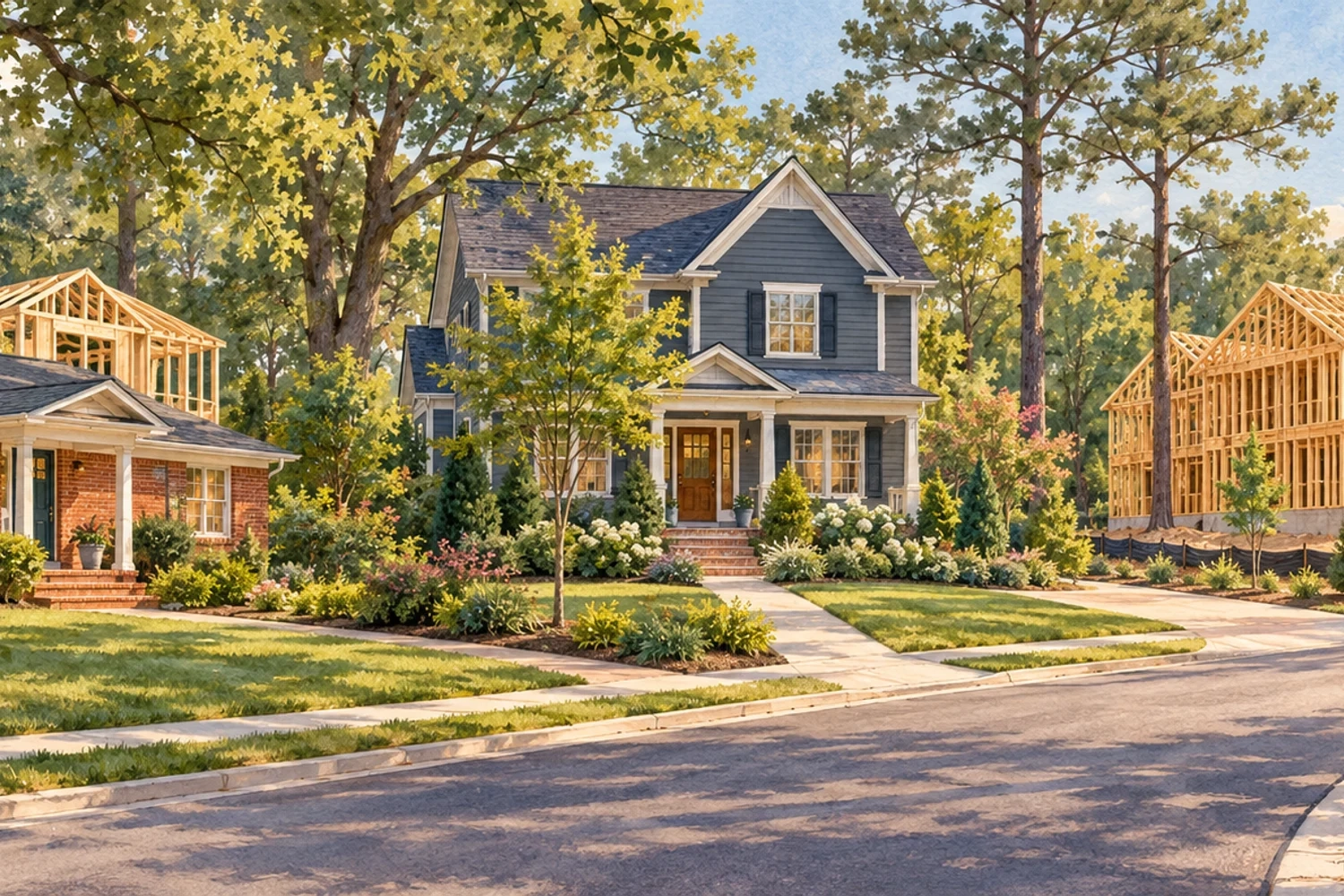
Original AI-generated watercolor-style illustration of fictional homes and new construction on a leafy residential street. No actual property, construction project, or landmark is depicted.