New - 16 Hours Ago



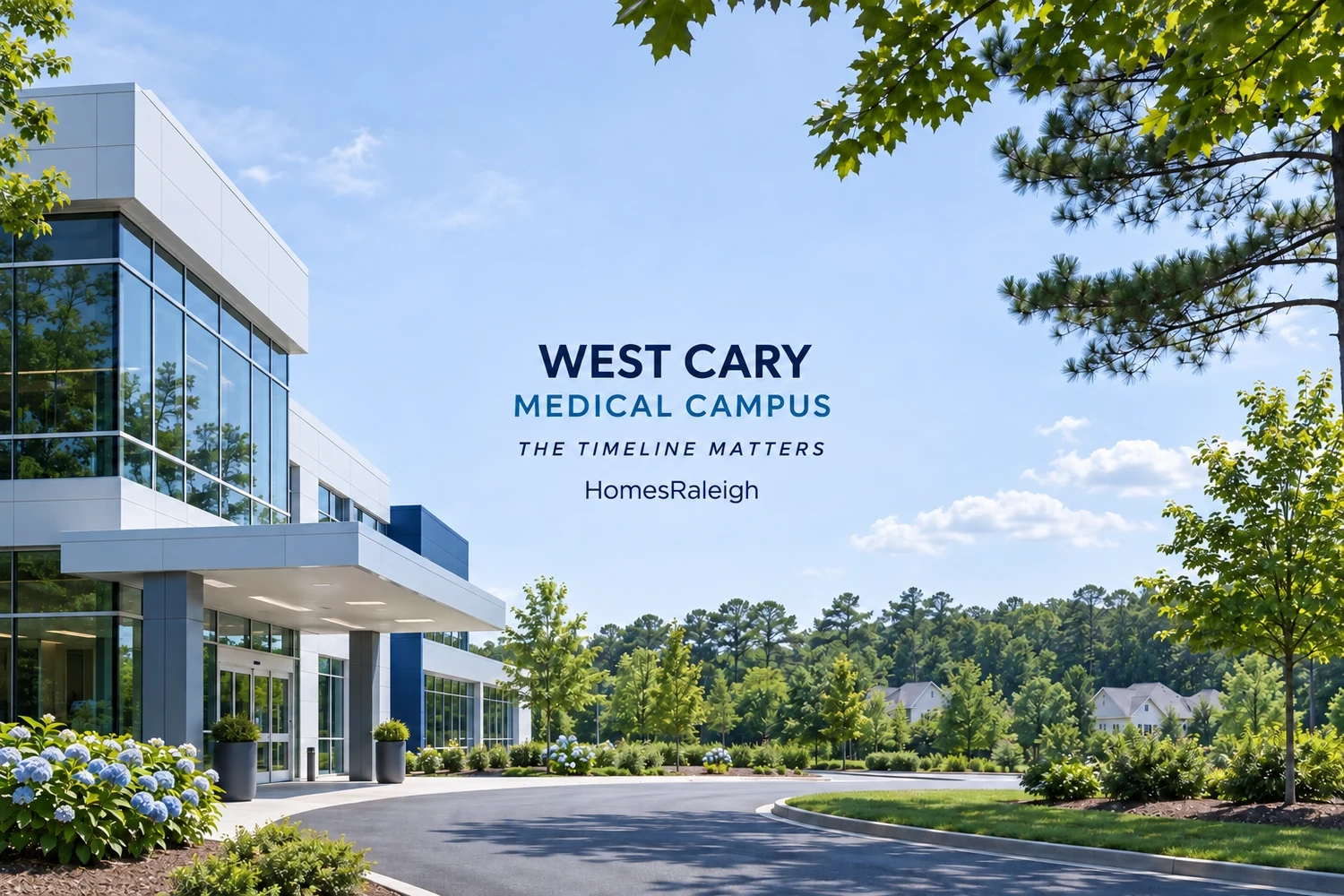
UNC Health's new medical campus near West Cary and South Durham could start treating patients in summer 2028. The hospital, however, isn't expected to open until early 2032.
Those staggered openings change what living near the development could mean.
Someone buying near Hopson Road in 2027 and planning to move again around 2029 could have new cancer care, imaging and specialty clinics nearby while crews are still building the hospital. A family staying for a decade could watch the 48-acre campus grow into a much larger healthcare destination.
Both scenarios follow the timeline UNC announced on October 6, 2026, when the health system confirmed construction had begun on its Cary Durham Campus.
The development is intended to serve West Cary, South Durham and Research Triangle Park, where a home's road connections and the years someone expects to live there could make these phases feel quite different.
Think about someone who needs regular cancer treatments or recurring appointments with a specialist.
The appointment itself may take an hour. Getting there, parking, completing tests and returning home can take considerably longer. Repeat that routine several times a month, and the location of medical care becomes a meaningful part of everyday life.
UNC Health's first phase is aimed at that kind of outpatient care.
The six-story, 192,000-square-foot medical office building is expected to open in summer 2028, alongside a parking deck with approximately 900 spaces.
The planned services include cancer care, with radiation oncology and infusion treatment, along with heart and vascular care, rheumatology, urology, obstetrics and gynecology, dermatology and orthopaedics. Imaging, laboratory and pharmacy services are also planned.
Bringing those services together could make certain appointments and follow-up visits easier for patients in this part of the Triangle.
For a West Cary household that currently travels farther for specialty care, the campus might eventually offer a closer option. Someone working around RTP could potentially schedule an appointment nearer to their normal weekday route.
The 2028 phase is outpatient care. The community hospital comes later.
UNC's opening dates are targets, and patients will continue using existing care locations until the relevant services become available. Which doctors practice at the new campus, their appointment availability and accepted insurance will determine how useful it is to an individual household.
UNC expects hospital construction to begin in 2028, around the time the outpatient building and parking deck are scheduled to open.
The community hospital is targeted for early 2032.
That creates a potentially unusual scene along Hopson Road: one part of the property operating as a medical destination while another remains under construction.
Patients could be arriving for imaging or specialist appointments. Employees could be coming and going. Meanwhile, crews could be working on the next major phase.
Consider two houses advertised as being close to the new UNC campus.
One might face part of the development property. Another could be farther away, reached through an entirely different set of neighborhood streets. Both could be described as convenient to UNC Health, yet their relationship to construction and everyday campus activity might be quite different.
The actual site layout, a home's position and existing road connections matter more than a broad description like "minutes from the new hospital."
The name Cary Durham Campus isn't just branding. It reflects the geography.
According to WRAL's October 6 reporting, the development is at 3490 Hopson Road Extension, off NC 55 between Green Level Church Road and T.W. Alexander Drive, between Cary and Research Triangle Park.
That's an area where daily life rarely fits neatly within a single community name.
Someone might own a home in West Cary, commute toward RTP and regularly visit businesses along NC 55. Another household could live in South Durham but spend much of its week traveling through Cary.
But proximity on a map doesn't necessarily translate into the same drive.
A home with a straightforward connection to NC 55 may offer a different trip than one whose neighborhood streets lead away from the corridor. A commuter who already uses T.W. Alexander Drive might encounter the campus differently from someone traveling primarily along Green Level Church Road.
Although the development is associated with West Cary, the North Carolina Department of Health and Human Services' Certificate of Need approval for the hospital identifies Durham County.
For homebuyers, the county distinction matters in a different way. A general West Cary or South Durham label doesn't establish an individual home's county, property taxes, school assignment or local services.
Durham County's land records and GIS resources help identify property locations, while the Durham development-record portal provides access to development and permitting information.
The surrounding area also has another healthcare project in the conversation: Duke Health's Green Level development. That's separate from UNC Health's Hopson Road campus.
For someone deciding between homes on different sides of this corridor, the practical distinction is less about which community name sounds appealing and more about where the property actually sits.
The completed campus is expected to employ approximately 1,000 people.
That would make the campus a substantial workplace in this part of the Triangle, with physicians, nurses, imaging and laboratory specialists, administrative employees and support staff traveling to the site.
One property might offer an easy connection to NC 55 for a Cary-to-RTP commute. Another might provide a quieter residential setting farther from the corridor, with a longer drive to the campus. If that choice spans Cary and Durham, the Cary housing market and Durham housing market provide current price and inventory context alongside those differences in daily travel.
For someone making regular specialist visits, the outpatient building could eventually bring relevant care closer to home. Another household might rarely need those services and care more about the work commute, school routines or the feel of its street.
A decade-long owner could eventually make use of the community hospital, too. A shorter-term owner may never live near the completed campus. The time someone expects to stay changes which parts of the development become part of everyday life.
If you're comparing these communities, our moving to Cary guide explores everyday life and housing choices around Cary. The guide to living in Durham, NC provides another perspective for households considering South Durham and other parts of the city.
On a map, UNC Health's Cary Durham Campus is a single destination. For someone choosing a home, it's several years of change along a corridor where daily drives already cross Cary, Durham and RTP.
A property's road connections, surroundings and fit with everyday routines will matter throughout that transition.
You can browse Cary homes for sale or explore Durham homes for sale to see what's available across both cities.
If you're deciding between West Cary and South Durham, or wondering how a particular home relates to the Hopson Road campus, contact HomesRaleigh to discuss the location, your expected move and the routes that will shape your everyday life.
HomesRaleigh conceptual illustration of a modern outpatient building in a leafy North Carolina setting. Not an actual photograph or architectural rendering of UNC Health's Cary Durham Campus.