New - 5 Hours Ago



Townhouse construction is slowing across the country. Builders started 42,000 attached single-family homes in the second quarter of 2026, down 9% from a year earlier.
Meanwhile, Raleigh's development records show 1,714 townhouse units approved under its Missing Middle zoning changes, with hundreds more under review.
That's a substantial amount of potential housing. But development approval isn't the same as a townhome being listed for sale, and a listing doesn't mean the home is finished or ready to move into.
For someone deciding between an existing Raleigh townhome and one offered as new construction, that difference matters. National building activity can influence future housing choices, but an approved development doesn't tell you when a particular home will be available—or what it will cost.
The decline extends beyond the latest quarter's year-over-year comparison.
According to an August 20, 2026, analysis by Robert Dietz, chief economist for the National Association of Home Builders (NAHB), builders started 159,000 townhouses over the four quarters ending in June. That's down 12% from 180,000 during the preceding four quarters.
Dietz points to affordability pressures affecting homebuyer demand, particularly in larger metropolitan markets.
Townhouses often appeal to buyers looking for an alternative to detached homes. But building smaller or sharing walls doesn't eliminate the financing and ownership expenses affecting the broader housing market. Buyers still have to be able and willing to pay for what's being built.
Even with the slowdown, townhouses represented 17% of all single-family construction starts in the second quarter of 2026. Measured over a rolling year, their share was 17.4%, down from a record 18.7% in the third quarter of 2025.
That remains above the previous two-decade peak of 14.6% reached in early 2008. The quarterly and rolling-year shares measure different periods, but they tell a consistent story: townhouse construction has weakened after reaching an unusually prominent position in new single-family housing.
Dietz remains optimistic about the longer-term potential for neighborhoods with a mix of housing types, although that's his outlook rather than a forecast for Raleigh.
There's also an important limit to what the Census construction figures reveal. They count homes beginning construction, not completed homes offered for sale. Some attached homes may be built for rent rather than purchase.
So while builders nationally are starting fewer townhouses than a year earlier, the numbers don't establish whether Raleigh buyers have fewer properties to choose from today.
The city's development records reveal why that distinction matters.
Raleigh has spent the past several years changing where different types of housing can be built.
Beginning in 2021, the city expanded its approach to Missing Middle housing, a term covering homes between traditional detached houses and large apartment buildings. Townhouses, duplexes, triplexes and small apartment buildings all fit within that broader category.
The changes opened more opportunities for smaller homes on smaller lots, including in areas where previous zoning rules were more restrictive.
Developers have pursued those opportunities.
According to Raleigh's Missing Middle Metrics, updated July 30, 2026, the townhouse figures are:
Those figures cover activity from July 6, 2021, through July 14, 2026. They're cumulative development statuses, not a count of townhomes built in 2026.
Raleigh classifies a unit as approved when the relevant subdivision or site review has been approved or a building permit has been issued. Construction may not have started. The city counts a unit as constructed when its permit is complete.
An approval moves a project forward. It doesn't tell you when the homes will be finished.
Even the 417 constructed units aren't necessarily available to purchase. Some could already be sold, occupied or held as rentals.
And the figures cover only development enabled by specific Missing Middle zoning amendments. They don't include every townhouse throughout Raleigh.
That's why these records can't establish whether Raleigh townhouse construction increased or decreased from 2025 to 2026. They measure a different activity over a different period than the national starts figures.
Nor do Raleigh's numbers describe the entire Triangle. Cary, Durham and surrounding communities have their own development rules and permitting systems.
Imagine a Raleigh renter planning to buy before their lease ends in January.
They find two townhomes worth considering.
One is an existing property. They can tour the actual home, evaluate its condition, arrange inspections and negotiate a closing date with the seller.
The other is new construction. They prefer its floor plan and finishes, but the builder hasn't completed it.
Both might appear in the same home search. Both might fit the buyer's budget on paper.
Only one is available as a finished home.
The unfinished townhome could still be the more appealing choice. But the buyer needs to understand how far construction has progressed, what the advertised price includes, how the contract handles deposits and delays, and whether the anticipated completion date works with their move.
A delay could mean extending a lease or arranging temporary housing. A resale purchase carries its own inspection and closing uncertainties, but the buyer isn't also waiting for construction to finish.
Someone with a flexible schedule may be comfortable with that tradeoff. Someone facing an inflexible moving date may not be.
Buyers can browse new-construction townhomes in Raleigh to see properties currently advertised for sale. But an active listing doesn't necessarily mean the home is finished. Its construction stage and expected closing date have to be established for that property.
And if both homes happen to fit the moving schedule, the next comparison isn't as simple as choosing the lower advertised price.
Raleigh's Missing Middle FAQ says most of the zoning changes allowing additional housing types don't carry binding affordability restrictions. The resulting homes are generally market-rate; the Frequent Transit Development Option has separate affordability requirements.
Suppose our renter finds that the existing townhome has a lower asking price than the new construction. The homeowners association (HOA) dues, if any, insurance costs and repair responsibilities for each home could change how their total ownership costs compare. One association might cover common-area maintenance while leaving certain exterior repairs to owners; another might divide those obligations differently.
The roof is one example. Neither home's dues alone establish who pays for repairs or replacement. Each property's governing documents determine that responsibility.
Taxes, potential assessments and other maintenance costs can shift the comparison in either direction.
Those differences matter when a buyer is considering a townhouse partly to reduce the cost or work of owning a home. HomesRaleigh's guide to Raleigh HOA fees and rules explains how to investigate association charges, documents and maintenance responsibilities before buying.
The builder might also offer a financing incentive or price concession that changes the comparison with a resale property. The buyer would need to weigh the offer against the full financing terms and total purchase cost; the national decline in townhouse starts doesn't establish that Raleigh builders generally are offering better deals.
The slowdown might tempt a Raleigh buyer to rush before choices shrink—or to wait for discounts. Neither move follows from these reports. National starts don't establish an approaching Raleigh shortage or predict local prices, and Raleigh's approvals don't tell buyers when suitable new homes will actually be offered for sale.
For our hypothetical renter, the decision is more immediate. If the new construction can't be completed before January, waiting may create costs and complications that outweigh its advantages. If the builder can deliver on a workable schedule, the buyer can compare its actual price, financing and ownership obligations against the existing townhome.
Another buyer, without a pressing deadline, could reasonably reach a different conclusion.
An approved townhouse adds to Raleigh's potential housing supply. One offered for sale may still be unfinished. And even a completed home needs a closing and move-in timeline that works for the buyer.
The right opportunity is the one that fits the buyer's timing, finances and ownership expectations.
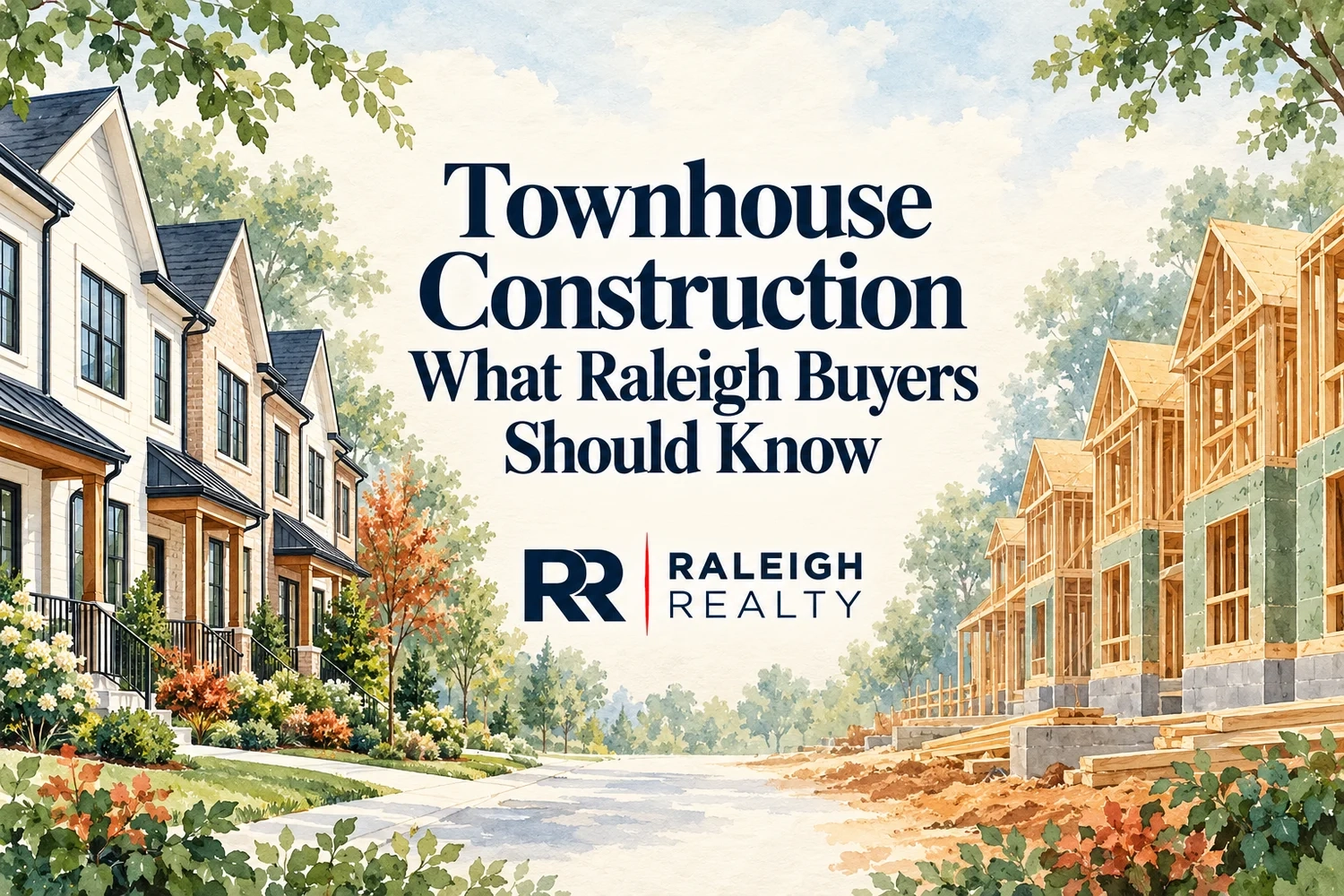
Conceptual illustration of townhomes and construction. No actual development, available listing or completion schedule is depicted.