




A Saturday in Durham can look very different depending on where you live. You might be carrying fresh produce home from the Durham Farmers Market, taking the kids to Oval Drive Park, heading to a round of golf at Hope Valley Country Club, or planning improvements to a historic home.
Those aren't just lifestyle preferences. They lead to different neighborhoods, recurring expenses, property responsibilities, and routes through the city.
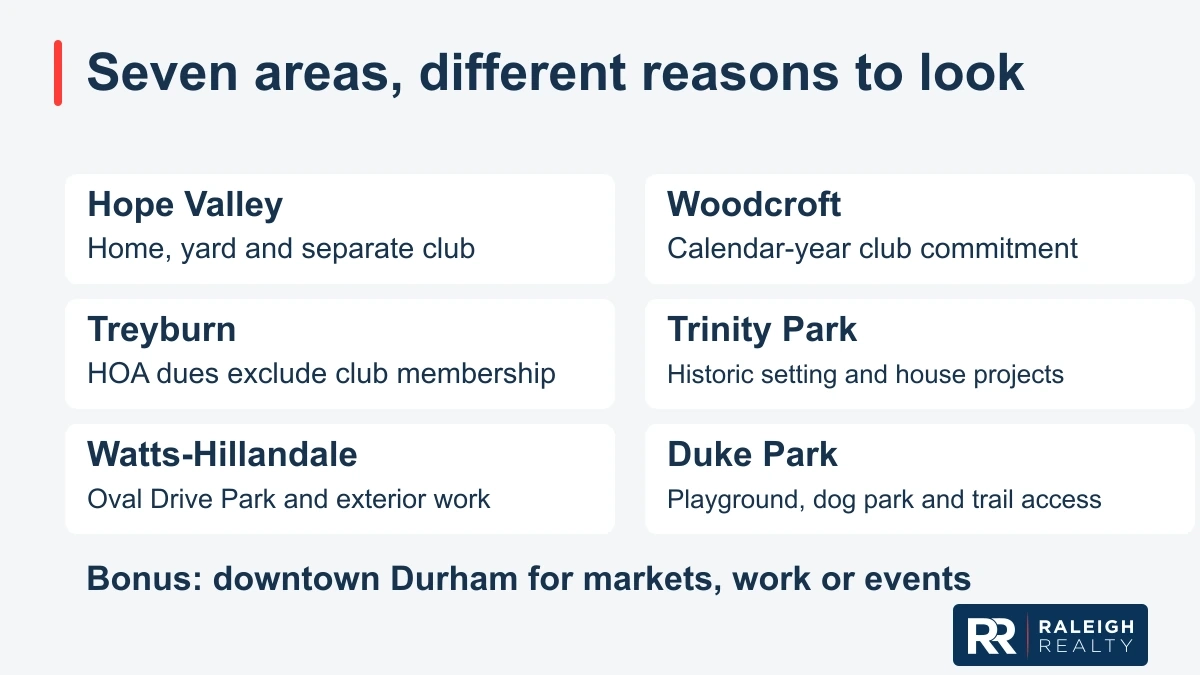
I'm Ryan Fitzgerald, owner of Raleigh Realty, and my seven selections for the best neighborhoods in Durham, NC, are Hope Valley, Woodcroft, Treyburn, Trinity Park, Watts-Hillandale, Duke Park, and downtown Durham as a bonus area.
These are preference-based recommendations, not a ranking of neighborhood quality. The best choice is the one where the location, home, and ownership obligations fit your priorities.
You can start by browsing homes for sale in Durham. If you're still deciding whether Durham is right for you, our guide to living in Durham, NC covers the broader relocation questions.
For market context, Doorify MLS reported a median sale price of $421,200 and 324 closed sales for its selected Durham market in September 2026, in a report updated October 13, 2026. The figures include single-family residences, townhouses, and condominiums within Doorify's selected market in its broader 18-county reporting system.
The $421,200 median is not a neighborhood-specific median or an estimate of any particular home's value. Likewise, the 324 closed sales should not be treated as an established count of every property transfer within Durham city limits.
Those figures offer background. Choosing a home requires a closer look at the places and properties you're considering.
| Neighborhood | Best for | Key difference |
|---|---|---|
| Hope Valley | Buyers comparing a home's layout and yard with private-club activities | Hope Valley Country Club offers golf, racquets, swimming, and dining; a nearby home purchase does not establish membership |
| Woodcroft | Buyers comparing home locations while considering nonresident club membership | Woodcroft Club accepts nonresidents, with calendar-year memberships and no summer-only option |
| Treyburn | Northern Durham buyers who value resident walking areas and club recreation | Resident walking trails and natural areas are separate from paid country-club membership |
| Trinity Park | Historic homes between downtown and Duke University's East Campus | National Register recognition does not automatically establish local exterior-review requirements |
| Watts-Hillandale | Public parks and historic-home considerations | Oval Drive Park has different facilities on either side of Club Boulevard; local historic rules depend on the parcel |
| Duke Park | Buyers who want convenient public recreation | A 17.24-acre public park offers a playground, dog park, trail access, and picnic facilities |
| Downtown Durham — Bonus | Markets, performances, workplaces, and downtown destinations | Individual buildings differ in entrances, parking, sound exposure, and ownership responsibilities |
The featured listings below cover Woodcroft, Treyburn, and Trinity Park, including active and coming-soon residential properties. They provide an opportunity to compare actual homes, not a filter confirming club privileges, historic restrictions, or renovation status.
Browse active and coming-soon residential listings labeled Woodcroft, Treyburn or Trinity Park.


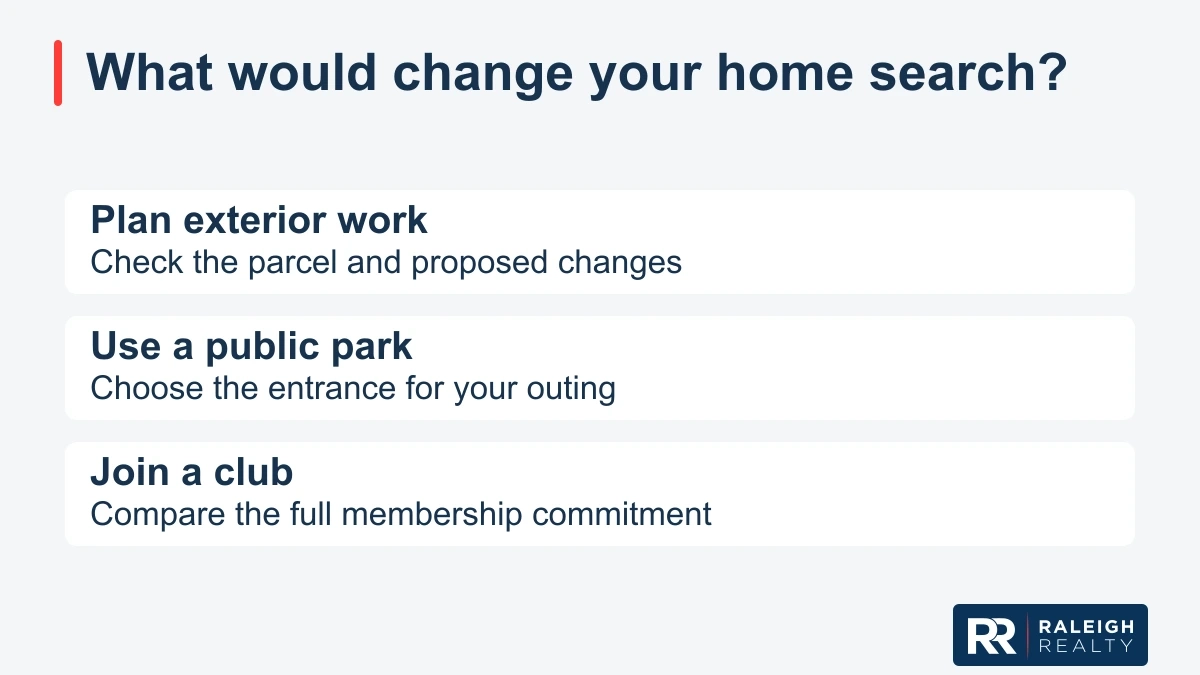
If public-park outings will be part of your regular week, start with the activity you have in mind. A playground visit and a basketball game at Oval Drive Park involve different entrances and potentially different crossings of Club Boulevard. Duke Park offers another mix of public facilities to consider.
For buyers drawn to historic homes, the important questions include which architectural details they want to preserve, what exterior work they propose, and whether the property's actual designation requires local review. Golf, swimming, or racquet sports may lead you toward private-club settings, where the cost and terms of membership need to be considered separately from homeownership.
If downtown markets, performances, or workplaces are your priority, compare the specific destinations and the routes home rather than relying on a broad downtown label. These preferences help narrow the areas worth exploring before you compare individual houses.
Before comparing individual homes, it helps to understand how these selections fit into Durham's geography.
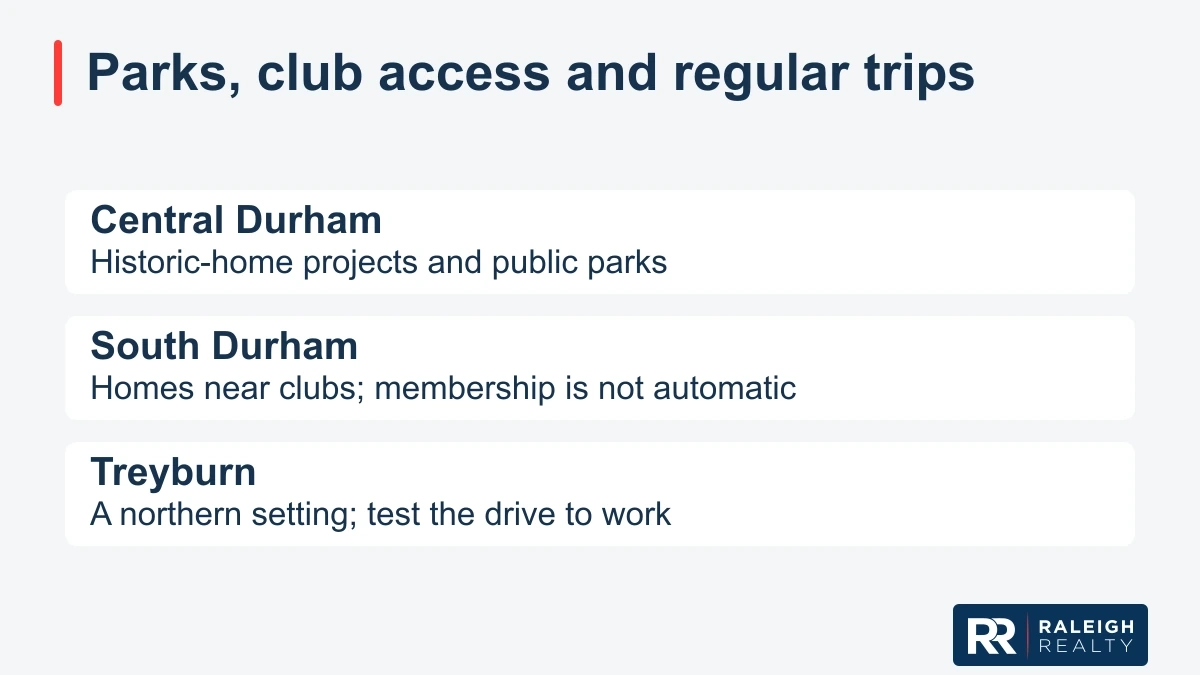
Central Durham provides different connections to public parks, Duke University's East Campus, and downtown destinations. Trinity Park occupies the area between East Campus and downtown. Watts-Hillandale and Duke Park offer particular public-park outings that may become part of your routine.
A route that works well for East Campus isn't automatically convenient for the playground at Oval Drive Park. Even among relatively central addresses, your actual destinations matter.
South Durham brings Hope Valley and Woodcroft into the conversation. Both provide opportunities to investigate nearby private-club activities, although their membership arrangements differ. For buyers interested in golf, swimming, or other club facilities, frequency of use can influence how much proximity is worth.
Northern Durham is represented here by Treyburn. Its resident walking areas and separately operated country club create recreational options, while its location needs to be evaluated against each buyer's ordinary work and errand trips.
A buyer might find two neighborhoods equally appealing for recreation, yet favor one because the drive to work, the grocery store, and back home fits the week better. Testing those trips from actual addresses gives the geographic comparison its practical value.
If regular golf, swimming, or racquet sports are part of your plans, Hope Valley Country Club at 3803 Dover Road is a reason to investigate Hope Valley.
The member-owned club features a Donald Ross-designed golf course, racquet sports, swimming, dining, and social activities. It offers local and nonlocal membership options.
Living near those facilities may be useful when you expect to visit frequently, although buying a nearby house neither establishes nor guarantees membership. Club enrollment has its own application, categories, and terms.
Suppose you're considering a Hope Valley property with a layout and yard you love, but its condition calls for substantial work. You may be willing to take on those projects, especially if the home's features would be difficult to reproduce in another property.
Necessary repairs and continuing yard maintenance will compete for room in your budget with any recurring club expenses you choose to take on. A buyer who expects frequent golf might be comfortable directing money toward both the house and membership. Someone who would swim occasionally may prefer to put more of that budget toward completed improvements or a layout that needs less work.
Documented repairs and inspection findings help you assess the home's condition and the work it may need. Relevant comparable closed sales help you evaluate its price, while the club's current written terms establish the separate charges for recreational activities. Together, those details show how the house and optional membership would fit into your budget without mistaking proximity for a membership benefit.
It's also important to distinguish Hope Valley from Hope Valley Farms, Hope Valley North, and other similarly named listing areas. They should not be treated as interchangeable simply because their names overlap.
For help distinguishing specific Hope Valley properties and similarly named areas, contact our team.
Woodcroft offers an interesting alternative for buyers who want recreational facilities without tying club eligibility to a particular residential address.
The Woodcroft Club allows nonresidents to become members. You could find a home that suits you outside Woodcroft and still consider joining, or choose a Woodcroft property because the house and location work well together.
Either way, it's worth understanding the commitment before including the club in your plans. Woodcroft Club memberships operate on a calendar-year basis, renew yearly, and do not include a summer-only option.
Members may arrange payments monthly, quarterly, semiannually, or annually. Those schedules change when payments are due; they do not shorten the membership commitment.
If you mainly want to swim for a few summer months, the full annual terms may weigh differently than they would for someone expecting frequent visits throughout the year. Compare the current charges with your intended use, then consider whether living close to the club improves the overall choice of home.
A Woodcroft property also comes with its own set of responsibilities. The applicable documents for a particular house or townhome establish who handles exterior maintenance, landscaping, and other expenses. Property type alone doesn't tell you precisely what those obligations will be.
If neighborhood paths are part of the attraction, examine where they lead and what uses are permitted. A trail may be enjoyable for recreation without connecting conveniently to errands. Seeing a path on a map—or watching other people use it—doesn't establish public access or permission to cycle. Check the current management rules, signs, and any adjoining segments before relying on a particular route.
Explore homes for sale in Woodcroft to begin comparing individual properties.
Treyburn combines a northern Durham setting with two different forms of recreational access.
The Treyburn homeowners association describes resident walking trails and natural areas. At 1 Old Trail Drive, Treyburn Country Club provides golf, racquet sports, aquatics, and fitness facilities.
A resident might use the community's walking areas regularly without joining the club. Someone else may be particularly interested in frequent golf or fitness activities. Treyburn HOA dues do not include country-club membership, and club enrollment and billing are handled separately through McConnell Golf.
A walking loop through Treyburn's resident natural areas might provide exactly the exercise you want close to home, yet do little to simplify a grocery run or work trip. From a particular property, the route to that loop, the country club, and destinations outside the community can differ substantially. Neither identical amenity access nor a particular commute is promised for every home.
Before choosing an address, trace the resident walking route you'd actually use alongside your ordinary work and errand trips. That comparison shows whether the northern Durham setting supports both your recreation and the rest of your week.
Browse Treyburn homes for sale and evaluate each property's condition, location, and applicable documents individually.
Trinity Park's appeal comes from the combination of its historic setting and its position between Duke University's East Campus and downtown Durham.
The Trinity Park Neighborhood Association describes the area's historic streets and buildings, including recognition on the National Register of Historic Places.
For someone who appreciates older-home details, that setting makes Trinity Park worth exploring. A porch, original architectural feature, or particular floor plan may be exactly what attracts you to a home, especially if preserving those features is part of your plan.
But suppose that same house has windows you want to replace or a porch that needs substantial work. The repair history and proposed changes become part of the purchase budget, and the home's exact historic designation may affect how those changes can proceed.
National Register recognition and Durham's local historic-district rules are not the same thing. National Register recognition does not, by itself, impose a blanket local exterior-review requirement on every home marketed as being in Trinity Park.
Durham also has locally designated historic districts, including Trinity Heights, which is separately named and must not be confused with Trinity Park. For a particular property, the applicable parcel designation—not the neighborhood label alone—determines whether local preservation rules apply.
Where those rules apply, projects such as replacement windows, porch alterations, or additions may require a Certificate of Appropriateness (COA). The proposed work is reviewed, approval is not guaranteed, and a COA does not replace any other required permits.
Before committing to a renovation budget, establish the home's condition and consult Durham's historic-preservation resources about the parcel and planned work. A project that preserves existing details may involve a very different scope from one intended to change them.
Start with Trinity Park homes for sale, paying particular attention to the individual property's condition and designation.
In Watts-Hillandale, Club Boulevard provides a useful example of why a park's layout matters when choosing a home.
Oval Drive Park occupies both sides of the road, with different facilities on each side.
North of Club Boulevard are the playground, open field, and amphitheater setting. South of Club Boulevard are the picnic shelter and courts, including basketball.
The Watts Hospital-Hillandale Neighborhood Association also identifies Indian Trail, Westover, and Belmont parks as neighborhood green spaces.
Imagine two buyers comparing properties near Oval Drive Park. One plans regular trips to the playground with young children. The other wants to use the basketball courts.
Both might reasonably say they want to live near Oval Drive Park. But a house with a convenient approach to the north-side playground may appeal more to the first buyer, while the second may prefer an easier route to the south-side courts. A crossing of Club Boulevard can also change the experience, even if both houses are advertised as being close to the park.
For buyers considering exterior projects, the property's precise location matters for another reason: Watts-Hillandale is a locally designated historic district in Durham.
A listing described as being in Watts-Hillandale doesn't automatically establish that its parcel falls within the regulated district boundary. Check the address against Durham's local historic districts information.
Where local review applies, proposed exterior work may require a COA. The actual parcel designation and the particular changes you intend to make determine the applicable process.
For help comparing Watts-Hillandale addresses, reach out to Raleigh Realty.
Duke Park offers a substantial public recreational destination without requiring private-club membership.
The 17.24-acre public park at 106 West Knox Street is open from dawn to dusk.
According to Durham Parks and Recreation, facilities include a playground, dog park, picnic areas, trail access, and restrooms. Picnic shelters can be reserved through the city's parks department.
The park is separate from Duke University's campus, despite sharing the Duke name.
For someone who regularly visits playgrounds, enjoys walking, or wants a public dog park nearby, those facilities could influence the kind of property they choose.
Suppose you're comparing one home with a large yard against another with less yard space but a convenient route to Duke Park.
If your preferred activities are playground visits, walking, and occasional picnics, the nearby public facilities may make the smaller yard more appealing, particularly if you'd rather spend less time on landscaping.
Someone who wants a substantial private garden or outdoor entertaining area may prefer the larger yard instead, because those activities depend on having the space at home.
For the smaller-yard option, convenience depends on the actual walk to the facilities you'd use. Duke Park's presence doesn't establish continuous sidewalks or equally convenient entrances from every nearby block. A route with suitable crossings and access may make regular park visits easier to incorporate into daily life.
If Duke Park is on your shortlist, we can help compare specific properties and their outdoor responsibilities.
Downtown Durham earns the bonus spot because a home here can be chosen around the destinations you expect to visit regularly.
Take the Durham Farmers Market.
The market operates at the Durham Central Park pavilion, 501 Foster Street, with markets on Saturdays year-round and Wednesdays seasonally. Its current calendar provides the seasonal hours.
For someone who visits regularly, a convenient trip to the pavilion could make the market part of a normal weekend. The journey home with purchases, however, may feel different from the walk there.
A building entrance, street crossing, or parking arrangement can affect how useful that proximity becomes. If you intend to drive, parking availability should be checked rather than assumed.
Nearby performances or a downtown workplace may add more reasons to choose the area, but the residential experience still varies by property.
Durham Central Park is one useful landmark. Downtown itself isn't a single uniform neighborhood, building type, or ownership arrangement.
A property may be convenient to several destinations while also presenting questions about street sound, building access, or parking. In a condominium, the governing documents and maintenance responsibilities add another consideration. Other downtown homes may have different arrangements.
The combination matters: the destinations you can reach conveniently, the experience of returning home, and the obligations attached to the building you're considering.
Begin with the broader Durham home search and narrow it to the downtown addresses that fit your routine.

Image courtesy of Raleigh Realty.


What if the home you want isn't available in your preferred Durham neighborhood?
Expanding the search to nearby incorporated towns and cities can provide more properties to compare without losing sight of your original requirements.
Chapel Hill, Hillsborough, Morrisville, Cary, and Raleigh are five alternatives worth investigating. They are distinct communities, not additional Durham neighborhoods, and their directions from Durham provide broad orientation rather than actual routes or travel times.
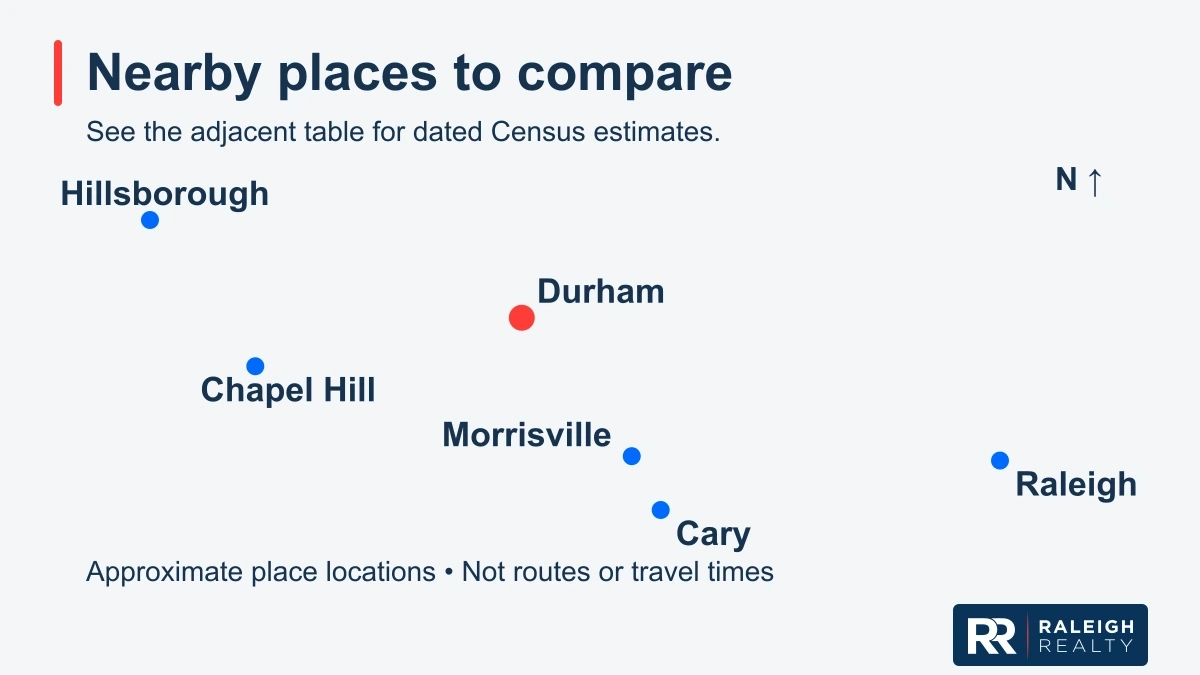
| Place | Direction from Durham | Population estimate | Median owner-occupied home value | Applicable school district resources | Homes/help destination |
|---|---|---|---|---|---|
| Chapel Hill | Southwest | 61,607 | $613,700 | Chapel Hill-Carrboro City Schools, Orange County Schools, or Chatham County Schools, as applicable to the address | Chapel Hill homes |
| Hillsborough | West/northwest | 9,724 | $460,100 | Orange County Schools | Address comparison |
| Morrisville | South/southeast | 31,422 | $518,800 | Wake County Public School System and Town assignment guidance | Morrisville homes |
| Cary | South/southeast | 179,306 | $580,200 | Wake County Public School System, Chatham County Schools, or Durham Public Schools, per Town address guidance | Cary homes |
| Raleigh | Southeast | 481,031 | $415,800 | Wake County Public School System, subject to the property's county and jurisdiction | Raleigh homes |
Source: U.S. Census Bureau, 2020–2024 American Community Survey (ACS) five-year incorporated-place estimates, with sampling uncertainty. The population figures are not current 2026 headcounts. Median owner-occupied home values measure existing owner-occupied housing, not current asking or sale prices for equivalent homes. They are also different from Doorify's September 2026 closed-sale median in population and period. School resources identify where to verify address-specific, school-year-specific assignments; they are not school-quality rankings or assignment guarantees.
Chapel Hill has the highest median owner-occupied home-value estimate among these five places, at $613,700.
That provides context about the existing housing stock, but the purchase-budget question is better answered through actual listings. Compare Chapel Hill homes for sale with similarly suitable Durham properties, keeping your required layout, condition, and location in view.
For school assignments, use the applicable district resources in the table and verify the specific address and school year.
Hillsborough has the smallest population estimate in this group, at 9,724.
Its smaller scale may make it worth including in a broader town comparison, but population alone doesn't establish larger yards, more property spacing, or convenient access to your destinations.
An individual address, lot, home condition, and the places you'll visit regularly provide a more useful basis for deciding whether Hillsborough belongs on your shortlist.
Morrisville can be a particularly useful alternative when a buyer's home search depends on reaching the same workplace or other recurring destination from different directions.
Compare potential Morrisville and Durham properties at the same intended arrival time, accounting for the actual building entrance, parking arrangement, ordinary stops, and return trip.
The town's school guidance also distinguishes nearby schools from assigned schools, making the address-specific check important.
Cary can broaden your selection of homes when several locations already meet your travel requirements.
At that point, compare properties with similar layouts, condition, and maintenance obligations rather than treating the town's overall home-value estimate as a property-level price.
The different school systems that may serve Cary addresses are another reason to use the town's address guidance and the applicable district's assignment information before drawing conclusions from a listing.
Raleigh provides a different city-level comparison, not simply another neighborhood option.
If you're deciding between Raleigh and Durham, compare available properties, destinations, and ownership costs alongside the broader features of each city.
Our Raleigh vs. Durham homebuying comparison helps frame that choice. If you want to expand your search further across the region, explore our guide to the best suburbs around Raleigh.
Once you've narrowed your search to a few areas, these five checks can help turn an appealing neighborhood into a property comparison grounded in your actual needs.
Start at the home's entrance and follow the route to the destinations you expect to use most often.
Consider the intended departure and arrival times, destination entrance or parking area, an ordinary stop along the way, and the return trip.
If you expect to walk, examine sidewalks and crossings along the route. A general description of a walkable neighborhood doesn't establish the conditions on every block.
For cycling, confirm that each relevant path permits bicycles. A trail's presence doesn't establish public permission for every activity.
If you plan to use transit, verify the current service and timetable against the journey you need. A nearby stop is helpful only when the route and schedule fit.
School information requires more precision than a neighborhood name or nearby-school map.
Confirm the applicable school district and address-specific assignment for the intended school year directly with the appropriate district.
Mailing addresses, county boundaries, and municipal names don't always resolve those questions by themselves.
The Federal Emergency Management Agency (FEMA) provides a Flood Map Service Center where you can review available mapped flood information for a property.
Mapped flood information doesn't reveal every past water problem or determine all insurance costs. Review the property's documented water history and physical condition, obtain an appropriate inspection, and speak with an insurer about property-specific coverage and quotes.
Together, those sources provide a more useful picture than relying on a map alone.
Request and review the relevant property documents before assuming what ownership includes.
For a home with an HOA or condominium arrangement, the applicable documents help establish maintenance responsibilities, owner obligations, and shared expenses. A single-family, townhome, or condominium label alone doesn't determine exactly who must maintain each feature.
If private-club activities matter, obtain current membership terms and charges separately. A club application, payment schedule, and HOA obligation answer different questions.
Historic-home plans require the same property-specific attention. Confirm the parcel designation and proposed-work requirements with Durham's historic-preservation staff. Applicable exterior alterations may require a Certificate of Appropriateness, approval isn't guaranteed, and other permits may still be required.
A closing attorney is the appropriate professional to interpret property-specific legal obligations and documents.
Two homes in the same neighborhood can present very different ownership decisions.
Compare layouts, inspection findings, documented improvements, repair needs, yard and tree maintenance, and relevant closed sales.
A renovated property still needs an inspection. A neighborhood-wide price figure doesn't establish the value of an individual house, and an attractive location or amenity doesn't guarantee future resale performance.
A property that appears less expensive at purchase may require more repairs or ongoing upkeep. Another might command a higher price while offering a layout and completed improvements that better serve your needs.
Consider which expenses will continue after closing and how the home's features fit your plans.
Your lender should explain financing terms and loan requirements. An insurer should address coverage and quotes. Those responsibilities are separate from real estate guidance about comparing homes and locations.
The objective is a property whose purchase price, condition, and continuing obligations fit together—not simply the most appealing address on the shortlist.

The seven areas I'd recommend considering are Hope Valley, Woodcroft, Treyburn, Trinity Park, Watts-Hillandale, Duke Park, and downtown Durham as a bonus selection.
Hope Valley and Treyburn may appeal to buyers interested in private-club activities. Woodcroft offers a different club-membership arrangement. Trinity Park attracts interest in historic homes and East Campus or downtown destinations. Watts-Hillandale and Duke Park offer different public-park opportunities, while downtown can suit people whose regular activities are concentrated there.
The right area depends on your preferences, budget, and the individual property.
Not necessarily.
Homeownership, HOA dues, and club membership are separate arrangements.
A home near Hope Valley Country Club doesn't guarantee membership. Treyburn HOA dues exclude country-club membership, which is arranged separately through McConnell Golf.
Woodcroft Club also accepts people who don't live in Woodcroft.
Verify the applicable membership agreement, eligibility, charges, and current terms before treating any club activity as a benefit of a particular purchase.
No. Woodcroft Club operates on a calendar-year membership basis with yearly renewal, and it does not offer summer-only memberships.
Payment schedules may be monthly, quarterly, semiannual, or annual, but spreading the payments across the year doesn't shorten the commitment.
Compare the full annual terms with how frequently you expect to use the club.
It depends on the actual property's designation and the proposed work.
Trinity Park's National Register recognition does not automatically create a local exterior-review requirement for every home marketed within the neighborhood.
Trinity Heights is a separately named local historic district, and Watts-Hillandale is also locally designated.
For properties subject to applicable Durham historic-preservation rules, certain exterior changes may require a Certificate of Appropriateness. Check the parcel, proposed work, and permit requirements with city staff before proceeding.
Not automatically.
A path may be privately managed, restricted to certain users, or subject to activity-specific rules.
Seeing a trail on a map or watching others use it does not establish public access or permission to cycle.
Confirm current management rules, signs, and any adjoining segments for the exact route and activity you have in mind.
North of Club Boulevard are the playground, open field, and amphitheater setting.
South of Club Boulevard are the picnic shelter and courts, including basketball.
If you'll use one of these facilities regularly, look at the specific entrance and any Club Boulevard crossing when evaluating a nearby home.
The citywide Durham listings below include active and coming-soon residential properties across Durham. They offer a broad starting point for a home search, not a filter confirming park access, club membership, historic renovation permissions, or property condition.


Choosing among Durham homes means weighing what each location makes convenient alongside the particular property's layout, condition, maintenance responsibilities, and continuing costs. The right balance depends on which activities and destinations matter most to you.
At Raleigh Realty, we can help you compare specific Durham addresses around your budget, home preferences, regular trips, and ownership considerations so that both the neighborhood and the property work for your plans.
Contact Raleigh Realty to discuss your shortlist, or begin by exploring homes for sale in Durham, NC.


